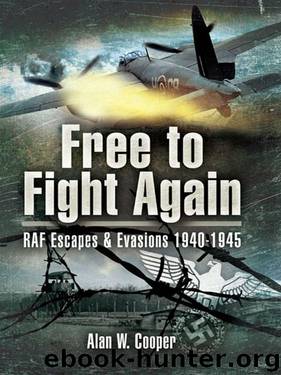
Free to Fight Again: RAF Escapes and Evasions 1940-1945 by Alan W. Cooper
Author:Alan W. Cooper [Cooper, Alan W.]
Language: eng
Format: azw3
Tags: Bisac Code 1: HIS027100
ISBN: 9781844688074
Publisher: Casemate Publishers
Published: 2012-07-22T16:00:00+00:00
Arnhem Evasion
On 20 September 1944 a letter was sent to Mrs Simpson from the commanding officer of 299 Squadron, Wing Commander Douglas Tiptree. This followed up the telegram which she had previously received advising her that her air gunner son, Sergeant Walter Simpson, was missing on air operations. On 19 September, two days after the Arnhem battle, known as Operation Market Garden, had begun, no communication had been established with 1st Airborne Division. The enemy opposition in that area was far greater than had been expected and the fortuitous arrival of a Panzer division, on rest, provided stiff opposition.
The air supply route to Arnhem on this day was changed to a southerly one, partly due to the weather and partly because it was hoped that the Germans would not be so well prepared for the change in direction. Take-off, however, was delayed until after midday because of continual bad weather.
For this operation 299 Squadron was to despatch 17 Stirlings. Finally, in the early afternoon, all seventeen aircraft took off on their support mission. In the rear turret of LJ868, letter ‘R’, flown by Flying Officer Geoff Liggins, was Sergeant Walter Simpson, known as Wally to his friends. They took off at 12.45 p.m. carrying 24 containers and panniers. At about 4 p.m., having successfully dropped their supplies into a wood north of the Rhine from a height of about 2,000 to 2,500ft, the aircraft was repeatedly hit by light and heavy flak and the port wing was set on fire. Flying Officer Liggins decided to crash-land the aircraft.
Wally Simpson left his rear turret to take up a crash position. After landing they finally came to rest, having first done a ground loop, on the southern bank of the Rhine about two miles south-west of Arnhem. They landed in the water meadows of the river behind the church at Oosterbeek with the turret just clearing the water’s edge. On impact the aircraft had broken up and was burning fiercely, and only the two RASC despatchers, Lance Corporal Prior and Driver Braid, and Simpson escaped free of injury. Simpson helped the badly injured wireless operator, Warrant Officer W. Rudsdale, away from the burning aircraft then realised that the flight engineer, Sergeant D. Gaskin, and the bomb aimer, Flight Sergeant K. Crowther, were still trapped inside. He returned twice into the blazing wreckage to release and rescue them and on the last occasion got clear by only about 30 seconds before the petrol tanks finally blew up.
In the meantime the pilot, Geoff Liggins, and the navigator, Flight Sergeant F. Humphrey, were rescued by Prior and Braid. During this time some Dutch civilians arrived, among them a lady doctor and nurses. Liggins was in great pain and was given morphine by Braid. All this was being done under German sniper fire and 88mm cannon shells which were being aimed at the burning aircraft. The injured men were carried away on makeshift stretchers made from ladders and taken to the village of Driel, where they were tended by Mr Hendrick, a first aid man, and Cora and Reat Baltussen.
Download
This site does not store any files on its server. We only index and link to content provided by other sites. Please contact the content providers to delete copyright contents if any and email us, we'll remove relevant links or contents immediately.
Fanny Burney by Claire Harman(26602)
Empire of the Sikhs by Patwant Singh(23084)
Out of India by Michael Foss(16853)
Leonardo da Vinci by Walter Isaacson(13336)
Small Great Things by Jodi Picoult(7139)
The Six Wives Of Henry VIII (WOMEN IN HISTORY) by Fraser Antonia(5514)
The Wind in My Hair by Masih Alinejad(5095)
A Higher Loyalty: Truth, Lies, and Leadership by James Comey(4960)
The Crown by Robert Lacey(4814)
The Lonely City by Olivia Laing(4801)
Millionaire: The Philanderer, Gambler, and Duelist Who Invented Modern Finance by Janet Gleeson(4478)
The Iron Duke by The Iron Duke(4354)
Papillon (English) by Henri Charrière(4274)
Sticky Fingers by Joe Hagan(4197)
Joan of Arc by Mary Gordon(4109)
Alive: The Story of the Andes Survivors by Piers Paul Read(4031)
Stalin by Stephen Kotkin(3965)
Aleister Crowley: The Biography by Tobias Churton(3640)
Ants Among Elephants by Sujatha Gidla(3467)
